Sachima: From Palace Pastry to Convenience-Store Staple
Sachima is a confection made from flour and eggs, formed into noodles, deep-fried until puffed, and then bound together with syrup and cut into blocks. According to research by the writer and confectionary expert Wagashi, the name is a transliteration of the Manchu word "sacima," a concept similar to "Manchu cake." Beyond Taiwan, Uzbekistan has a similar treat called "Chak-chak," made of deep-fried noodles bound together, though it uses hot honey instead of syrup. The "Ma Zai" or "Ma Zai" found in Hong Kong is also a similar variety.
From Qing Dynasty Imperial Pastry to Contemporary Affordable Snack
Looking at its name, it is easy to see that Sachima originated from the Manchu people, with references even appearing in Qing Dynasty literature. For example, the "Yanjing Suishiji" (Record of Annual Customs in Yanjing) mentions its preparation, showing that this deep-fried, syrup-coated noodle snack has long existed in Chinese food culture. However, unlike its early role, which was often tied to festivals, rituals, or specific occasions, Sachima in Taiwan gradually integrated into daily life. It evolved from a traditional pastry into a national snack that everyone can buy and enjoy, developing its own distinct Taiwanese character in the process.
The writer Liang Shiqiu once criticized the Taiwanese version in "Yashe Tanchi," calling it "too big and thick, the noodles too coarse and hard, with too little honey—a name without the reality, completely off the mark." Reading this critique today, it feels more like a historical record of the localization of Sachima. Through the constant adjustments and innovations of the Taiwanese people, Sachima did not remain in its original form but gradually evolved in a direction better suited to local dietary habits.
By the 1980s, Taiwan began producing Sachima using machinery and adding ammonium bicarbonate, commonly known as "smelly powder," to create a fluffy texture, resulting in a Taiwanese style distinct from traditional Chinese craftsmanship. In 2004, the mainland Chinese national journal "Cereal & Feed Industry" published a study on the production process of "Taiwanese-style Sachima," marking the academic recognition that Taiwanese and Chinese Sachima are two different technical systems. A closer look at the differences reveals that the Taiwanese version uses ammonium bicarbonate to enhance fluffiness, resulting in a light and airy texture, while machine mass production ensures consistency. The finishing touch—raisins incorporated into the dough—can be considered part of the "authenticity" of Taiwanese-style Sachima.
Interestingly, Taiwanese people have not only redefined how Sachima is made but have also developed various unique ways to eat it. Some prefer to flatten the Sachima by hand first to enjoy a denser, more compact texture; others soak the flattened Sachima in milk, allowing the sweetness of the sugar and the richness of the milk to meld; others still prefer to peel it apart along the noodle strands, savoring it one piece at a time. These seemingly casual eating habits reflect how Taiwanese people always manage to integrate foreign food into their daily lives, creating their own food culture through the act of consuming and sharing.
The Art of Flour, Oil, and Sugar
In terms of technique, Sachima is primarily composed of flour, oil, and sugar. Eggs are typically added to the dough to stabilize the structure and prevent it from collapsing, while ammonium bicarbonate is added to the dough to release carbon dioxide during high-temperature frying, causing the noodles to expand and become airy, which gives Taiwanese Sachima a much higher level of fluffiness than traditional versions. In other words, the ammonium bicarbonate determines the "quantity" of the air pockets, while the eggs determine the "quality"—both are indispensable. Once the dough is prepared and cut into strips, it is deep-fried at approximately 180°C to puff and set, then flattened and pre-cut in preparation for the syrup coating.
As for the syrup, its temperature and water content are the core variables that determine the texture. The syrup is usually a blend of granulated sugar, which crystallizes easily, and maltose, which does not, with the ratio controlling the final degree of crystallization and the "melt-in-the-mouth" quality. Some also add a pinch of salt to enhance the dimension of the sweetness, or a small amount of salad oil to add sheen. Once the syrup is ready, it is "sprayed" onto the noodles to coat them evenly, followed by drying, pressing into molds, and cutting into final pieces.
- Crispness/ Is the first bite light or heavy?
- Airiness/ Is the overall structure loose or dense?
- Sugar Profile/ Does the sweetness have layers and a lingering finish?
- Oil Aroma/ Do the noodles themselves have a distinct aroma?
- Melt-in-the-mouth Quality/ Does it leave the mouth feeling clean or coated after eating?
Contemporary Versions of Sachima and Its "Horcruxes"
In June 2026, T/ABLE hosted a lecture titled "The Etymology, History, and Craft of Sachima," where various products were provided for tasting:
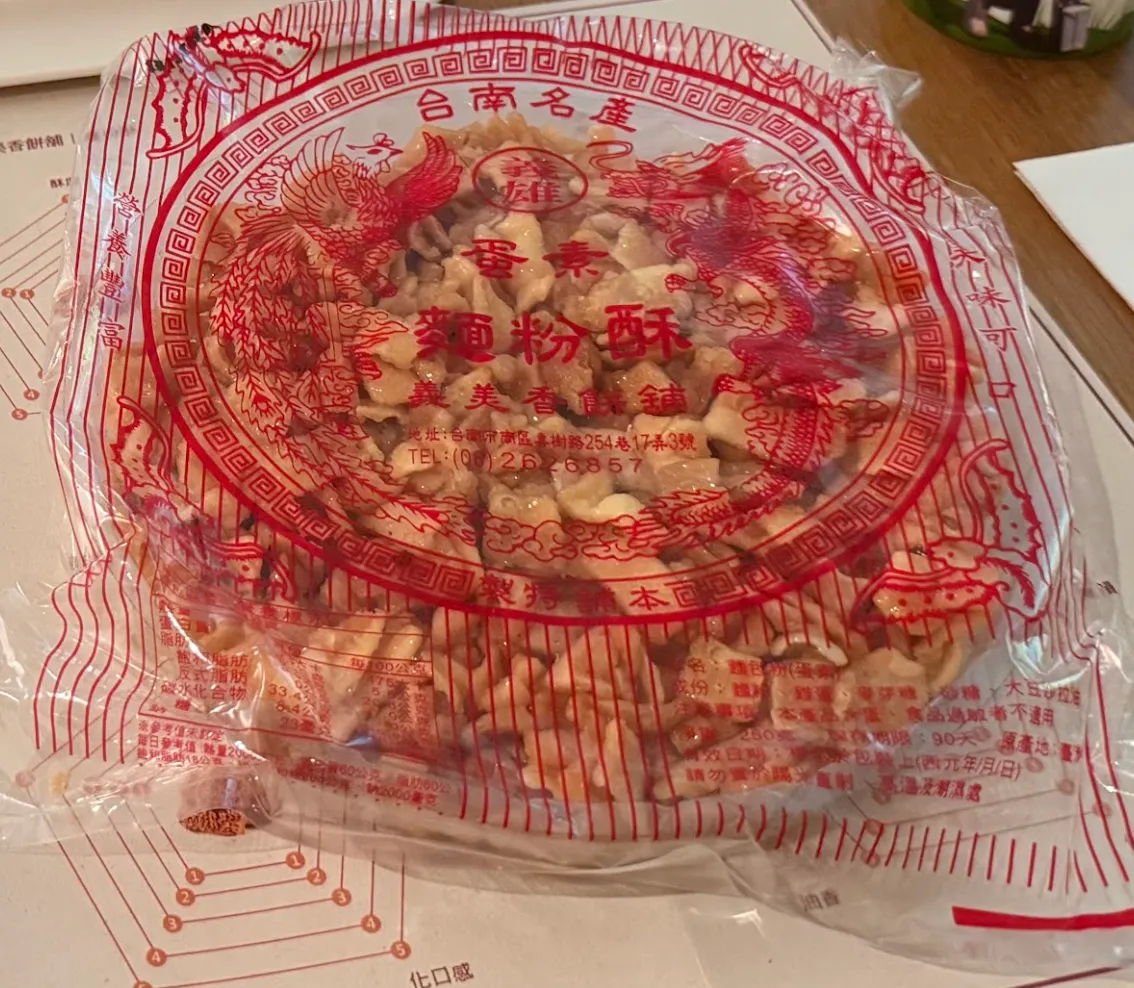
- Mianfen Su (Flour Crisps): Author and wagashi researcher Kazashi discovered that Mianfen Su were used as wedding cakes in the 1960s and 1970s. At that time, having a piece of Mianfen Su in a wedding cake box was a symbol of prestige for the bride's family. Producers innovatively used molds to create smaller portions, making them more accessible. Interestingly, in terms of ingredients, production methods, and texture, Mianfen Su and Cunzao (inch-long dates) are strictly speaking not Sachima. However, in the memories and daily vocabulary of many, these snacks are often viewed as being closely related to Sachima. In other words, for many, Sachima is not a single food item, but a constantly evolving family of snacks.
- Qingchun Hao: Inspired by the concept of "Cunzao," this brand emphasizes a hard, crunchy texture rather than a soft one, with clean, fragrant oil as its core selling point.
- I-Mei Foods: The packaging features both Chinese and Manchu characters for "I-Mei" and "Sachima," and the ingredients include dried fruits and various grains.
- De-Yi Foods: One of the first manufacturers in Taiwan to mass-produce Sachima, and a representative brand that has taken Taiwanese Sachima to international markets.
- Sanguang Foods: Known for their "Papaya Crisps," these are small, granular pieces that resemble a cluster of papaya seeds. Author Kazashi notes that this aligns with Qing Dynasty records describing the snack as being "chopped as fine as glutinous rice."
- Yu Jan Shin: Positioned as "non-fried Sachima." The oily texture comes from fats added to the sugar syrup rather than the frying process itself, while the soft texture is achieved through a special syrup formula rather than the use of leavening agents like ammonium bicarbonate.
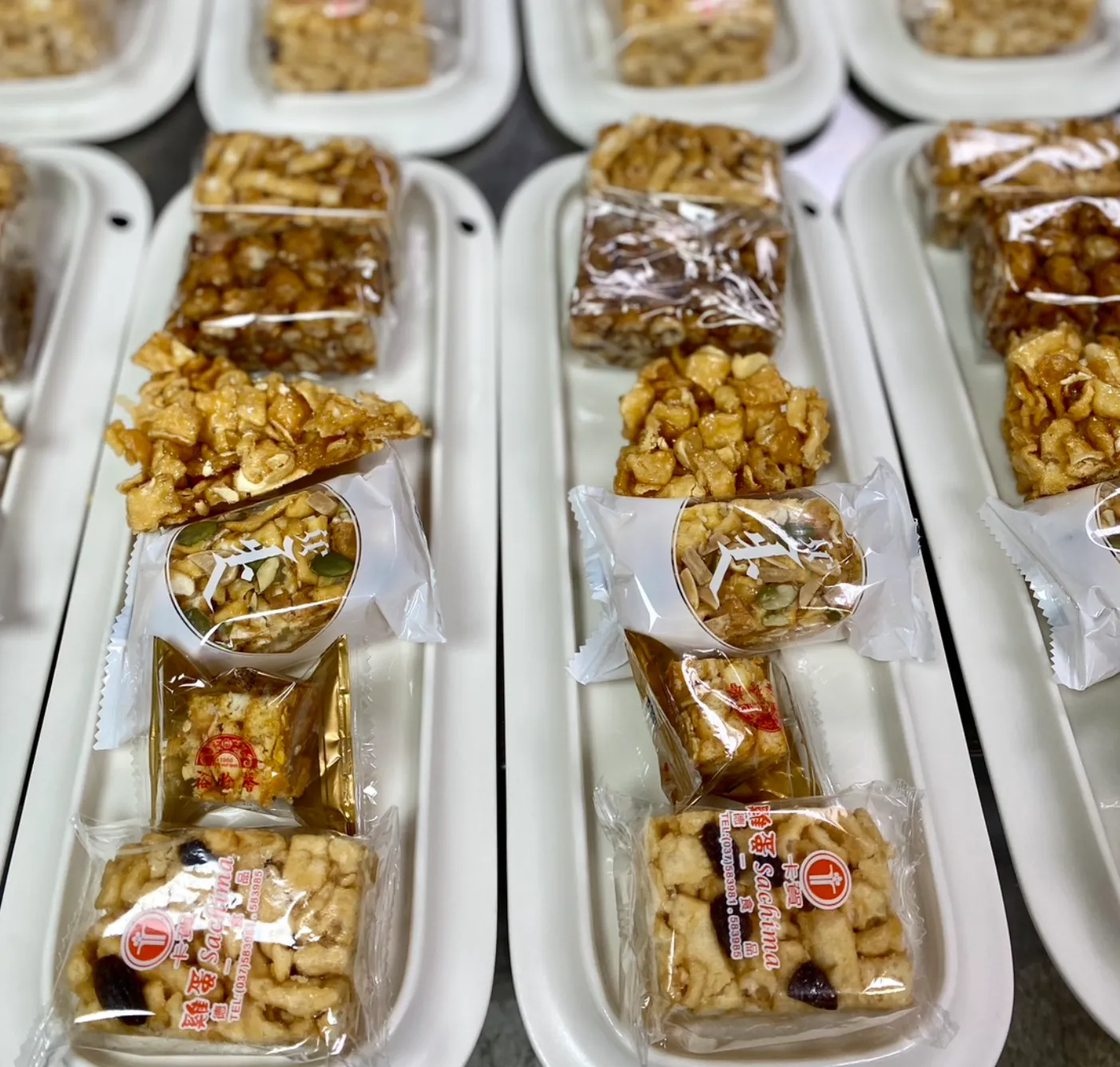
Looking at the history of Sachima in Taiwan, one can see its transformation across different eras. It was once a sacrificial offering in the Qing imperial court, a substantial Beijing-style pastry described by writers in Taiwan after 1949, and is now an everyday snack found on convenience store shelves. Recently, Taiwanese Sachima has largely developed along two paths: "health-conscious" and "cultural tracing." The former replaces frying with baking to promote a "non-fried" healthy image, incorporates grains and dried fruits to replace traditional ingredients, and reduces overall sweetness to suit modern dietary preferences. The latter looks back to the Qing imperial prototype by using fermented butter and baking techniques.
However, the most fascinating aspect of Sachima is not just its historical context, but the fact that it remains a living part of everyone's life. Everyone has their own way of eating it, and behind every method lies the life memories of different generations and regions. Next time you visit Taiwan, if someone offers you a piece of Sachima, don't be in a rush to ask if it's "authentic." The truly interesting question might be, "How do you eat it?"
This article was compiled and edited based on transcripts and summaries from the T/ABLE food culture lecture series, as well as the researcher's field notes. All brand information is accurate as of the original source material.
Content Editor: Michelle Guo
Reviewer: Andy Hsu
Photo: The One