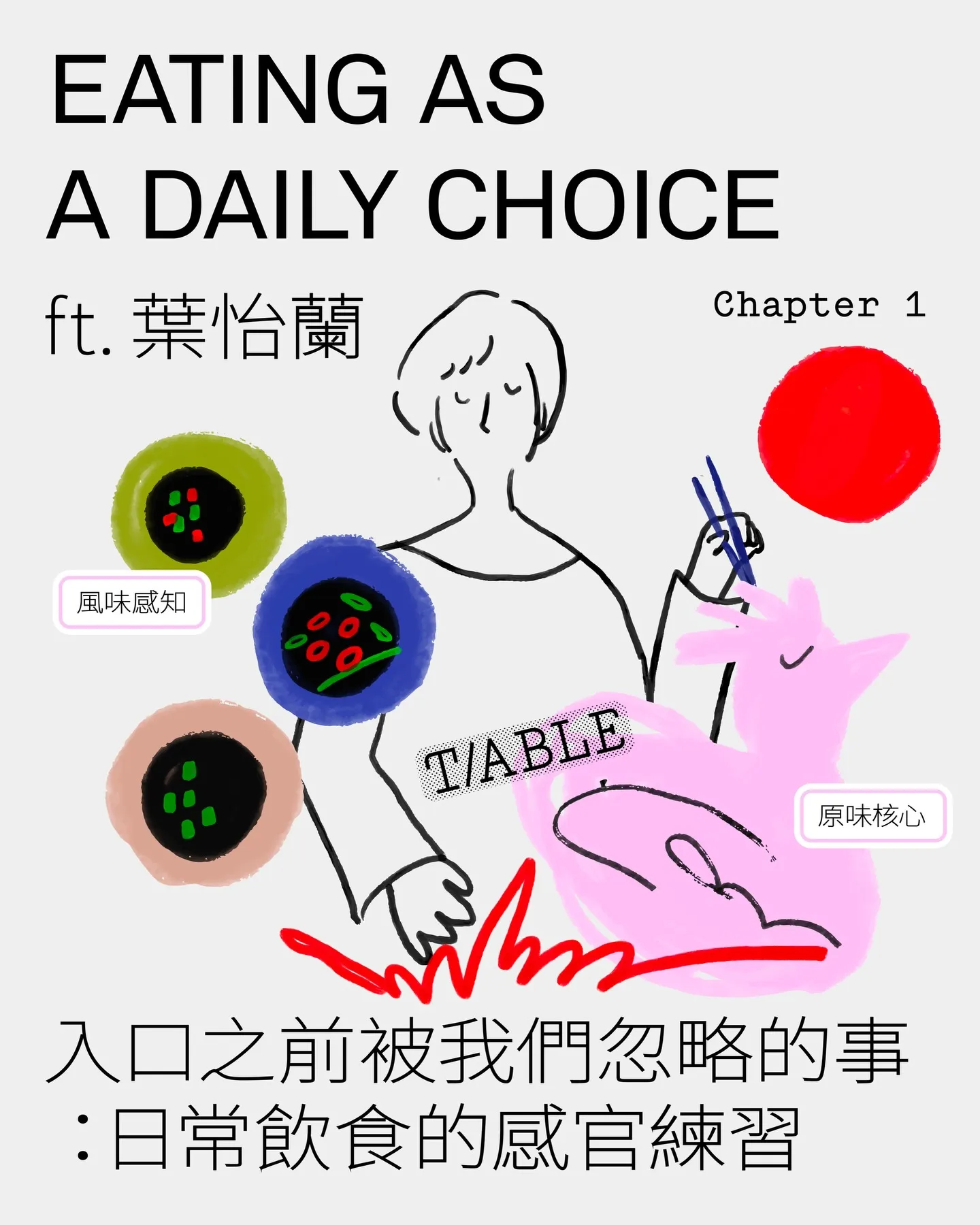
What we overlook before we take a bite:
Sensory exercises in daily dining ft. Yi-Lan Yeh
How did you decide on your first meal today?
You scroll through a food delivery app during a break and quickly settle on a bento box; you walk into a convenience store and reach for the same item on the familiar shelf. There are plenty of options and the decisions are made quickly, but we don't always have the luxury of truly savoring the experience. Convenience itself isn't the problem, but as choices become increasingly effortless and intuitive, are we still able to taste what is right in front of us?
If Taiwanese flavor exists beyond classic dishes, cultural narratives, and history, then where does it actually happen? The answer may be hidden in every one of our daily choices.
The second episode of T/ABLE TALK features food and lifestyle writer Yi-Lan Yeh. Starting from everyday experiences like drinking water, brewing tea, and cooking, she discusses how our senses can be awakened and, through long-term practice, become a way to understand food, the land, and ourselves.
Yi-lan has spent years writing about food, tea, travel, and objects, while also documenting her own dining table, turning "how to eat" into a subject worthy of careful consideration. Hsu Chung recalls that even before he entered the culinary industry in 2001, he began learning about European wines, Taiwanese ingredients, and lifestyle aesthetics through her articles.
This episode does not ask how to make life more complicated, but rather how we can reclaim our capacity for perception and choice in the repetitive act of eating every day.
Practicing a mindful life: Sensory education in daily routines
Many people often read "delicacy" and "refinement" into Yi-lan's writing, but to her, these terms feel somewhat overly complex and deliberate. She prefers to define her life as "earnest."
"Most of the joy in my life actually comes from the act of living earnestly," says Yeh. This earnestness is reflected in the layers of discernment she applies to her daily choices.
She uses the universal need to "quench thirst" as an example. When thirsty, instead of grabbing a bottle of water from a convenience store fridge, she asks herself: "Do I want water, tea, juice, or something else right now?"
If she decides on tea, should it be cold or hot? If hot, is it Taiwanese, Japanese, or Western tea? If she chooses Taiwanese tea, does her body need the warmth of black tea, the freshness of green tea, or the lingering finish of oolong? Breaking it down further, oolong can be a deeply roasted Dong Ding, a crisp and aromatic high-mountain oolong, or a lightly fermented, floral Wenshan Pouchong. Finally, there is the choice of the right vessel and water temperature.
This isn't about turning tea-drinking into a complex exam, but rather transforming a physiological instinct into a conscious action—recognizing what we encounter, think, and need in the moment. Andy Hsu believes this is how sensory education is implemented in daily life: when people are willing to bring awareness to their actions and understand the meaning behind their choices, their senses can achieve a more complete experience and sense of pleasure.
Tracing taste memories from the kitchen
Yi-lan began to consciously confront her own perceptions when she started cooking in her own kitchen.
Born in Tainan, she moved to the north alone for university and eventually settled there. The damp, cold climate of Taipei and the unfamiliar seasonings and aromas on the dining table left her feeling a strong sense of displacement, so she began to cook for herself. At first, she took a copy of Fu Pei-mei’s Cookbook from her mother’s shelf, but when she opened the pages and tried to follow the recipes in her small northern kitchen, she quickly noticed something was off: "This isn't right. This isn't what we eat at home. The flavors of these dishes are vastly different from the taste of our dining table back in Tainan."
The true inspiration for her culinary journey was actually another book, "The Complete Family Cookbook." Instead of precise measurements, it categorized ingredients and provided guidance through narrative descriptions. The ample white space gave her room to exercise her own judgment; even without someone standing by to guide her hands, the sensory memories accumulated during her childhood naturally directed her movements.
"When I look back at my cooking, I realize that what I put together so naturally is all the flavors I grew up eating in Tainan." The repeated trials and adjustments in the kitchen may seem like a struggle with ingredients, but in reality, it is a process of piecing together the flavors that are most familiar to her.
If one's understanding of hometown flavors comes from daily accumulation, then, looking at the bigger picture, is the so-called "Taiwanese taste" also hidden within recurring ingredient choices and cooking methods?
"Original Flavor" is not laziness: Finding the presence of ingredients
In her early years, while traveling to different countries to explore ingredients and wines, Yi-lan was often asked, "What is Taiwanese cuisine like?"
She gradually realized that this question could not be answered simply by listing a few representative dishes. To understand the character of Taiwanese cuisine, one must return to the familiar family dining table and re-examine those seemingly ordinary flavors to see what kind of culinary logic they share.
In 2005, Yi-lan proposed that "the taste of Taiwan is the original flavor." Original flavor is easily misunderstood as being bland, under-seasoned, or even doing nothing at all; however, the original flavor she speaks of is closer to allowing ingredients to retain their presence: designing seasonings and applying techniques on the foundation of preserving the ingredient's flavor. When eating chicken, one should be able to recognize the taste of the chicken; when eating fish, one should be able to feel the texture and freshness of the fish. This ability to see the essence of food forms an important clue in her understanding of Taiwanese taste.
"The basic dietary structure and character of Taiwan begin with simplicity." Yi-lan believes that compared to culinary systems long dominated by imperial banquets and aristocratic rituals, much of Taiwan's daily diet is closer to an immigrant society, seasonal produce, and the lives of ordinary people. Its sophistication is hidden in the selection of ingredients, the control of heat, and the way seasonings are used to highlight the ingredients.
She also compares the different paths of Eastern and Western cuisines: some Western cuisines excel at using stocks, sauces, and various elements layered on top of one another to build a three-dimensional and complex flavor structure; whereas Eastern cuisines, such as Taiwanese and Japanese, more often rely on heat, time, and seasoning to allow ingredients to gradually meld together in a single dish.
This is not an absolute classification between East and West. Contemporary kitchen techniques have long transcended regional boundaries, and layering and melding can both appear in a single dish. However, this comparison still serves as a reminder that the sophistication of a dish does not necessarily rely on complex forms; sometimes, the simpler it is, the more one can see the chef's skill.
Andy echoes Yi-lan with the Taiwanese culinary principles of "clarity, freshness, and quick stir-frying": "Clarity" means a clean, refreshing taste that is processed cleanly without masking ingredients with heavy seasoning; "freshness" emphasizes the freshness and inherent flavor of the ingredients; and "quick stir-frying" relies on heat control and speed, capturing the moment when the aroma rises and the ingredients reach the perfect level of doneness.
A plate of white-cut chicken perfectly showcases the layers of this "original flavor" aesthetic. While it may seem like simply boiling and slicing a chicken, it actually involves the breed, the age of the bird, subcutaneous fat, the boiling method, internal temperature, and resting time. Yeh Yi-lan rarely uses dipping sauce when eating white-cut chicken because she wants to directly experience whether the chicken itself has flavor; Hsu Chung further breaks this experience down into a traceable method through "knowing the taste, savoring the taste, and playing with the taste."
"Knowing the taste"
This is about first establishing your own criteria for judging food. Taking white-cut chicken as an example, Hsu Chung believes that a chicken needs to reach sexual maturity and be raised for about 100 to 120 days for the meat to have sufficient chicken aroma, and the skin should have a moderate amount of elasticity. This standard may not apply to everyone, but the point is to first know what you are looking for, so that you can then begin to identify where "delicious" comes from.
"Savoring the taste"
This further utilizes measurement and comparison. Hsu Chung once tested the doneness of white-cut chicken with Solo Pasta chef Wang Chia-ping, using a probe in the kitchen to record the internal temperatures of different parts: about 73°C for the leg and 66.5°C for the breast. To get the leg and breast of a single chicken to reach their ideal states simultaneously, the chef must use the traditional "three-in, three-out" basting technique, using residual heat to complete the thermal conduction, and finally brushing it with rice wine and salt. These numbers are not universal formulas, but rather a demonstration that sensations previously described only as "tender," "juicy," or "just right" can also be measured and compared to find more concrete conditions for their formation.
"Playing with the taste"This brings the ingredients back to the life context of different regions. Hsu Chung once worked with Kai-Shin Native Chicken to test the variables of nearly 300 chickens. He discovered in his fieldwork that preferences for white-cut chicken are also related to local experience: people in Hsinchu prefer thick-skinned, elastic capons dipped in kumquat sauce; fighting cocks with firm meat are common in Taitung; while Tainan prefers smaller, flavor-concentrated black-feathered native chickens.
The same dish of white-cut chicken will yield different answers for what is "delicious" due to different produce and eating habits. "Knowing, savoring, and playing with the taste" is not a requirement for every diner to conduct experiments on the same scale, but rather a path to understanding one's preferences: Do you care more about the texture, the aroma, or the dipping sauce? Does the texture you like come from the breed of the chicken, the chef's heat control, or the way you've been eating it since childhood? Senses help us discover differences, while science helps explain them.
Following the trail of "original flavor," one also discovers that it is not a pure starting point untouched by culture, waiting to be rediscovered. Behind a seemingly simple plate of white-cut chicken, there is still breed cultivation, farming conditions, local sauces, cooking techniques, and family memories; flavor is always the result left behind by the intersection of time, place, and human choices.
After the fusion, what flavor remains?
When discussing Taiwanese cuisine today, the term "fusion" is often used to describe its diverse facets. However, fusion usually describes the final result on the table, while the process of transformation is easily overlooked. When Taiwanese flavor is simplified to fusion, what Hsu Chung and Yilan Ye first want to clarify is: after constant blending, what exactly gives a dish the character that belongs to this island?
"It’s not that we’re just mixing things up without a core," says Yi-Lan. Although the Taiwanese dining table is colorful and diverse, there are two powerful cohesive cores behind it: "seasonality" and "festivals."
Seasonality is the unspoken agreement between people and the land. Once the bamboo shoot season passes, people look forward to the sweetness of summer loofahs and melons; when winter arrives and the cold wind blows, spinach and crown daisy accumulate their sweetness in the soil, and the dining table shifts along with the phenology. Festivals are collective milestones that transcend ethnic groups: the Buddha Jumps Over the Wall on Lunar New Year's Eve, street barbecues during the Mid-Autumn Festival, and the popiah feasts in Tainan families during the Qingming Festival. Even if every family eats different dishes, they still respond to time through food at similar moments, starting from their own family, ethnic, and local experiences.
Within this fusion, there is also a clever local transformation. When foreign cuisine enters Taiwan, it is adjusted through repeated daily practice. For example, Sichuan spicy hot pot was originally known for its heavy beef tallow and intense spices, and the broth was usually not meant for drinking; in Taiwan, it has gradually evolved to reduce the heaviness of the tallow, incorporate the sweetness of vegetables and medicinal herbs, and even become a broth that can be enjoyed on its own. Foreign forms are not passively preserved but are re-selected through the sensory logic familiar to Taiwan.
When a society forms a strong and indispensable consensus on life in its daily routines, many cultural identifiers can emerge naturally without the need to rush to prove oneself to the outside world.
"Don't rush"—let flavors take root in daily life first
Yi-Lan uses bubble tea as an example. Bubble tea was able to travel from Taiwan to different cities not because there was a grand cultural narrative pushed to the world first. Behind it lies Taiwan's long-accumulated tea industry and the demand for cold drinks brought by the hot climate; Taiwanese people love diverse combinations and are skilled at blending tea with toppings, while the shops scattered across the streets and daily consumption together support a complete industrial system.
It first became a daily staple that many people drank repeatedly before it gradually acquired the cultural recognition to spread abroad.
Of course, doing things well does not mean they will naturally be seen. Andy also shares a reminder he received while studying at the University of Gastronomic Sciences in Italy: the problem is not just whether it tastes good, but also how it is expressed. When people can perfect the local produce and familiar flavors they care about, and explain them clearly and concretely, they naturally have a better chance of finding their own place.
Bringing the experience back to the daily dining table
The first episode started with "Why talk about Taiwanese flavor?"; in this episode, Yilan Ye brings the method of searching for Taiwanese flavor back to the daily dining table.
How was your first meal of the day decided? This seemingly simple question can be the beginning of experiencing Taiwanese flavor. Food culture comes from the life consensus formed by a group of people over a long time, and making conscious choices only requires a little more mindfulness in daily actions.
However, when everyone starts to voice their own taste, which voices will be seen, believed, and even become public standards? Once personal feelings enter restaurants, media, and rating systems, "delicious" is no longer just a personal matter.
In the next episode, T/ABLE will invite food critic Liz Kao and Solo Pasta chef Chia-ping Wang to discuss from the different positions of critic and creator: who really gets to decide what is delicious?
Your keyword for Taiwanese flavor? — Yi-Lan Ye
"Original Flavor"
"I think the keyword is 'original flavor.' This is not just the character of the food, but also symbolizes the simple, local, and down-to-earth spirit of the Taiwanese people. This taste comes from our extraordinary insight and sensitivity to the essence of food; it runs through our protection of the terroir and embodies our underlying ability to perceive the essence and hold onto the core spirit even under the influence of diverse cultures."
Yi-Lan Yeh | One of Taiwan's most influential food writers and the founder of "PEKOE Grocery." Through over twenty years of writing practice and life observation, she has profoundly defined the coordinates of Taiwan's daily aesthetics. From her early days at Tomorrow News to her numerous books on food and tea culture, Yilan Ye has always advocated for "original flavor" as the core character of cuisine, and through the practice of "living life earnestly," she leads the public to transform intuitive sensory pleasure into conscious aesthetic choices.
This article is compiled and edited based on the program topics and interview structure planned for *T/ABLE TALK*, the actual recorded content of the podcast, and the viewpoints and supplementary materials provided by the guest during the interview. Quotes, identities, and related names in the text are based on the original recordings and materials provided by the guest.
Content Editor: Lien Hsiu-chu


