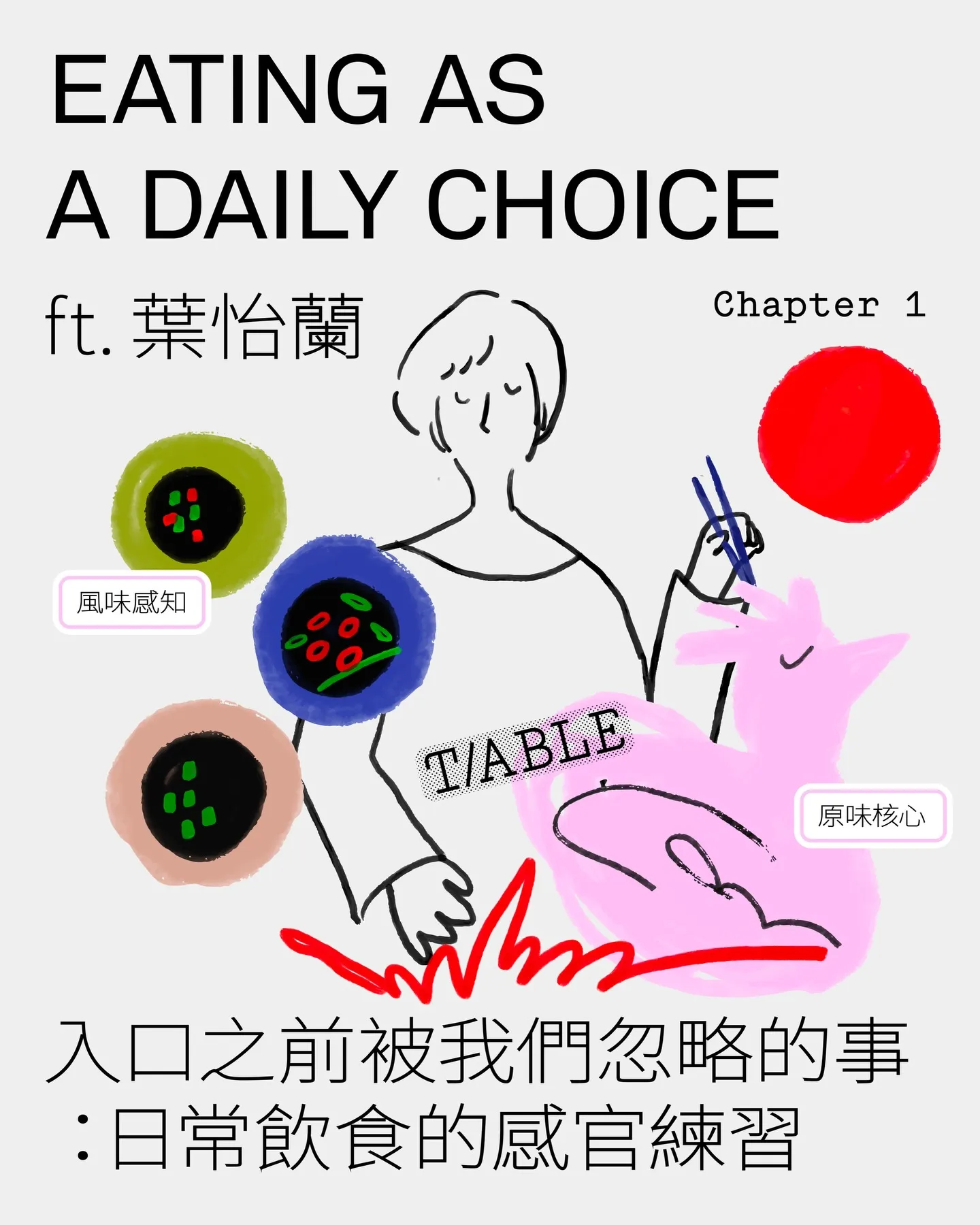
What’s on the Taiwanese table? The past and present of Taiwanese taste feat. Wei-Hsiung Chan
Searching for the cultural origins of a spoonful of Taiwan
In recent years, "Taiwanese taste" has been continuously renamed and repackaged. Bistros boast about reviving classic Taiwanese flavors, fine dining establishments reinterpret street food, and debates over northern versus southern tastes are a constant fixture on social media. Taiwanese taste has never seemed more visible, yet it is often reduced to visual symbols, marketing jargon, or social media hashtags.
Is it a fragrant bowl of braised pork rice on the street corner, or local ingredients meticulously reinterpreted in a Michelin-starred restaurant? When people argue over which shop is the most authentic or which recipe is the most "Taiwanese," are they defending a standard of taste, or are they defending their own ways of growing up, living, and understanding this island?
The birth of T/ABLE TALK is not intended to provide a black-and-white answer to what Taiwanese taste is. As founder Andy Hsu says, when T/ABLE hands a spoon to the audience and invites everyone to scoop up a taste of Taiwan, the scenery reflected in that spoon will inevitably be different for everyone. Perhaps the question worth asking is not which dish best represents Taiwan, but rather how these flavors were formed, why they remained, and whose life experiences they carry.
For the first chapter of this series, T/ABLE invites veteran cultural critic Wei-Hsiung Chan to engage in a dialogue with food culture researcher Andy Hsu. Chan has long used cultural sociology as a framework to analyze the changes in Taiwanese society; his classic work, The Economics of Aesthetics (2005), profoundly inspired discussions on "style" and "taste" in Taiwan. When he talks about food, he often traces personal sensory experiences back to social structures, observing how a society begins to value perception and how individuals gradually come to know and reconstruct themselves through what they eat and what they like.
In the dialogue, Andy Hsu points out that defining "Taiwanese taste" is as difficult as defining "aesthetics": both are hard to describe in a single form, yet both are closely linked to the public's life experiences. Borrowing an aesthetic perspective is not about distancing food from daily life, but about asking further: how do people perceive, judge, and explain their own tastes? How do these seemingly private choices reflect the subjectivity gradually forming in Taiwanese society?
Following Wei-Hsiung Chan's train of thought, this episode begins with Immanuel Kant's philosophy of aesthetics to explore how Taiwanese dining has gradually loosened from the collective order of the industrial era toward an "aestheticization of daily life" that values individual perception and judgment. It then combines the three fluid coordinates proposed by Andy—"time, geography, and humanity"—to understand how Taiwan's unique geopolitical intersections and historical experiences have shaped a highly flexible sense of taste identity.
Therefore, before rushing to ask "what is Taiwanese taste," perhaps we must first return to a more fundamental question: when did people start trusting their own senses and viewing "what they like" as something worth identifying, expressing, and discussing?
From Kant to the dining table: When did people start caring about their own perceptions?
Wei-Hsiung Chan does not rush to list which dish best represents Taiwan; instead, he brings the question back to the starting point of how modern people come to understand their own perceptions.
"When Kant was analyzing human reason, he realized there was a kind of emotional stirring that could not be fully analyzed by reason alone." Chan uses the term "aesthetic stirring" to describe this experience. When a person faces something and feels an involuntary flutter of the heart, or even a tremor, the feeling at that moment cannot be explained by a formula.
Throughout the long history of human civilization, one of the most overlooked daily stirrings is "taste." This transformation has a clear trajectory in history. In the latter half of the 18th century, the prototype of the modern restaurant began to appear in Paris. Around the time of the French Revolution, the old social order loosened, and dining gradually moved from private residences to public spaces, expanding the possibilities for people to pursue individual taste experiences. Chan understands this change as a process in which individual subjectivity gradually enters daily life.
Chan cites Kant's famous quote from "An Answer to the Question: What is Enlightenment?": Enlightenment is the emergence of man from his self-incurred immaturity. Kant gave three examples of refusing to think for oneself: letting books think for you, letting a pastor decide your conscience, and letting a doctor prescribe your diet. Chan extends this concept to the dining table: when recipes start deciding for people how to cook and how to taste, are people losing the ability to perceive and judge? Relying on authority and tools sometimes means that the ability to think, judge, and perceive one's own subjectivity is atrophying.
"If you want to become a person capable of self-growth, you must care about the various things in your daily life that can give you rich sensations," observes Chan. Over the past fifteen years, Taiwan has also undergone its own "aestheticization of daily life." More and more people are starting to care about which bakery a loaf of bread comes from, what ingredients are used in a dish, and why the same dish tastes different in different places. What we eat and what we wear no longer strictly follow existing social norms; they are gradually becoming ways for individuals to explore their ideal lives.
This also brings up a question: when people choose what to eat or wear today, are they also telling others who they are? Chan replies: "You are what you eat. You are what you wear." Today, food does more than just fill the stomach; it gradually carries people's imaginations of an ideal life. This statement sounds like a crisp manifesto for living, but behind it lies the changes that have taken place in Taiwanese society over a long period.
A plate of cafeteria food, preserving the taste of a collective era
The awakening of this subjectivity has not been an easy journey for Taiwan.
From the 1950s to the 1970s, Taiwan pursued an industrial economic miracle. During this state-led industrialization process, a massive labor force left rural areas for cities and factories. Production emphasized discipline, speed, and uniformity, and life was organized into the rhythm of collective operations.
"In that era, any individual sensory stimulation or subjective experience was suppressed and rejected. You had to restrain any impulse because you had to conform to collective life," recalls Chan. At that time, people had to wear uniforms to work in factories; physical characteristics—whether tall, short, fat, or thin—were deliberately erased, and even their stomachs were formatted to the schedule of the factory cafeteria.
It was a taste profile that pursued "risk-free, standardized, and safe" flavors. Whether in Keelung or Pingtung, the dishes on the cafeteria buffet were almost always the same: tomato scrambled eggs, shredded pork with dried tofu, stir-fried water spinach in summer, and stir-fried spinach in winter. It wasn't meant to stimulate you; it only required you to finish eating quickly and mechanically so you could return to production immediately.
During the same era, Andy encountered another example while conducting fieldwork.
At the time, Taiwan was in the heyday of exporting canned white asparagus. Not only was white asparagus bought in bulk by factories, but it was also a prized ingredient at banquets. When Hsu interviewed the farmers who grew it and asked how they prepared white asparagus at home, the answer he received was: "How could we eat it? That stuff is meant to be sold." When he pressed further, asking if they didn't even keep the trimmings, the farmers said the most they would do was boil them into an asparagus water to quench their thirst.
This experience reminded Andy of the farmers he had interviewed in Italy, who would eat the crops they grew and were happy to explain how to cook them best. In contrast, the relationship between Taiwanese farmers and white asparagus was one of producer and factory commodity, which did not necessarily serve as a path for the producer to understand their own land and palate.
However, the efficiency-driven past should not be simplified into a history of culinary poverty. For many families, cheap, stable, and fast were simply the living conditions they had to face; the fact that food choices are more abundant today does not mean people are better at eating.
Although people no longer eat according to the factory cafeteria schedule, they may now be following rankings, algorithms, and social media trends to consume a different set of "standard answers." External guidance has not disappeared; it has simply changed form. What appears to be free choice may, in essence, be another form of "standardization." When the senses lose the ability to discern individual differences, people may once again return to that blinded era.
When does a society begin to allow people to spend time identifying differences and treat "what I like" as something worth saying out loud? Chan has interpreted the recent changes in Taiwan's dining scene as the awakening of both the diner's palate and the artisan's craft at the same time. While foreign evaluations like the Michelin Guide have entered Taiwan, bringing with them a new set of standards and power, they also raise another question: If French cuisine has a mature set of criteria, how should Taiwanese cuisine be understood? Can the flavors familiar to Taiwan be explained in their own language?
"Taiwanese flavor" has become an issue at this moment precisely because the existing culinary order is changing. Some want to preserve it, some want to innovate, and others have begun to question whose life the flavors previously labeled as "authentic" actually represent.
If taste is personal, why fight over what is authentic?
Behind all these discussions, the reason taste is so compelling may be because it plays a part in everyone's "self-narrative."
When discussing "narrative," Chan explains it as a process in which a person is constantly answering the questions: "Where do I come from, who am I, and where do I want to go?" Every new sensory experience has the potential to supplement or rewrite the original answer. Food is so critical precisely because it appears repeatedly in daily life and enters the body most directly, becoming a profound intervention.
The meaning of a dish is never determined by a recipe alone. The same bowl of soup is seasoned and cooked differently in every home; some taste frugality in it, some remember the warmth of being cared for, and others may be reminded of an unpleasant relationship. Taste can perpetuate identity, but it can also be the starting point for someone to leave old habits behind and choose a new life.
This also brings up an unavoidable question when trying to understand "Taiwanese flavor": If everyone has such private, subjective taste memories, is there still a need to talk about a collective "Taiwanese flavor"? If any flavor that happens in Taiwan and is liked by Taiwanese people can be included, will "Taiwanese flavor" become a term that encompasses everything but explains nothing?
In 2006, Andy traveled to Italy to study at the University of Gastronomic Sciences (also known as the Slow Food University), founded by the Slow Food movement. The question he encountered in his first class provided another way to understand this issue.
The professor at the Slow Food University asked students from different countries: "What is Italian cuisine?" Some answered pizza, others said pasta. The professor replied: "What you said is all correct, but none of it is entirely accurate. There is no unified Italian cuisine in the world. Italy is composed of 20 regions with different historical backgrounds. There is only Tuscan cuisine, Sicilian cuisine, or, more strictly speaking, only the food my mother makes."
Italy did not complete its unification until the 19th century, and each region already had its own produce, lifestyle, and culinary traditions. While it is convenient to summarize it as "Italian cuisine," it easily erases the differences that actually exist between regions.
This class led Hsu to begin understanding food through three coordinates: Time, Place, and People. Time allows us to see in which era a dish was formed and what changes it has undergone; Geography influences what produce is available in a place and what preservation and cooking methods are developed; People bring their own memories, craftsmanship, and migration experiences, constantly rewriting the appearance of food.
1. Time: This refers to the specific point in time or period of food culture being discussed. It ranges from the daily scale of three meals a day to seasonal, annual, or even the entire lifecycle.
2. Geography: This examines how the local geography during that specific period shaped the available produce and dietary patterns.
3. Humanities: This focuses on "who" was engaging in these dietary practices within that time and space, as well as the migration, interaction, and shifting identities of the people involved.
This methodology also corrected how Andy previously understood the history of Taiwanese cuisine. At the time, he was accustomed to tracing the origins of Taiwanese food back 400 years, starting with documents left behind after Han Chinese migrated to the island. His Italian mentor, however, countered with a question: "Before the people from the Qing Dynasty arrived in Taiwan, were there no humans on this island? Why not include the diet of the indigenous people in your timeline?" This question highlighted a perspective often overlooked in food history: where you begin your narrative determines whose lives are seen and which flavors are excluded.
From this, we can understand that "authenticity" is not entirely a fabrication, but rather a consensus formed by a group of people in a specific time and place after long-term practice. However, it is not an immutable boundary. As populations move, produce changes, or new generations join, established flavors are naturally adjusted or even challenged.
What we should truly be wary of is not people trying to identify shared flavors, but rather the act of presenting the answers of one era or one group as the only answer for everyone.
Chan points out that when a society begins to emphasize a certain "archetype" or "orthodoxy," it often indicates that the existing order is undergoing drastic change. In this context, the routine debates on social media about "Southern-style vs. Northern-style zongzi" every holiday, or the heated arguments over whether to stir minced pork rice or mix curry rice, are actually vivid cultural practices. Flavors are never just about taste; they are tied to how a person grows up, how their habits are formed, and the values they hold dear.
"I am very eager for these battles to happen," Chan says with a smile. The more people are willing to gather around the stove and pay attention to food, the richer the forces of adjustment applied to it become. Hsu Chung also welcomes these debates: "We argue because we care. If you didn't care, you wouldn't even bother to defend it."
Debates do not need to result in a perfect answer. The commonality of Taiwanese flavor does not lie in everyone eating the same thing, but in people being willing to discuss why they eat differently.
If there is no single correct answer, can Taiwanese flavor still be described?
Commonality is not the same as a standard answer, yet it cannot be entirely without definition. Is it possible to describe a shared flavor tendency without turning it into a boundary that excludes differences?
Through practical research and synthesis, Andy attempts to draw a boundary for Taiwanese culinary flavor that provides a basis for public discussion. He condenses his observations into: "The taste lies between salty and sweet; the essence is in the layering of spice and acidity."
Andy uses Taiwanese sausage as an example. When his Italian friends tasted the sweet sausage, they asked in surprise, "Why do you like to put sugar in meat?" In his observation, the "spice" in many Taiwanese dishes comes from the gentle stimulation of white pepper, and acidity is frequently found in fermented foods and vinegar. The combination of salty and sweet, layered with spice and acidity, forms a recognizable flavor profile.
Wei-Hsiung Chan adds a perspective from another angle: "The strength of Taiwanese flavor lies precisely in its ability to be a culinary system that flexibly embraces various tastes." He uses South Korea as a comparison, where foods like kimchi and grilled pork belly have become easily recognizable cultural symbols. Taiwan, having experienced population migrations and culinary exchanges across different periods, has formed a diverse and inclusive food landscape that is difficult to anchor to just a few dishes. When new flavors arrive, they are often adjusted, absorbed, and eventually become a part of daily life.
This elusive quality, which defies easy definition, may actually be the very condition that allows Taiwanese chefs the freedom to innovate.
"The vast majority of Taiwanese people find an extension of their own narratives and a sense of spiritual comfort in the flavors they choose; this is, in fact, the greatest advantage for modern chefs." Chan Wei-hsiung further suggests that in a modern society shaped by repeated fusion and refinement, those ancient, primitive flavors can sometimes become the most novel and avant-garde experiences of all.
Take Wes Kuo, chef of the Michelin Green Star restaurant EMBERS, as an example. He ventures into mountain forests and streams, seeking the bitterness and astringency of river fish offal prepared with indigenous ingredients. These ancient pickling techniques, which had once faded from daily life, are being reinterpreted through contemporary dining, becoming a strange yet fresh sensory experience for today’s diners.
These two perspectives can coexist perfectly on the contemporary Taiwanese dining table.
Some discuss terroir, fermentation, and aroma in natural wine bars or modern Taiwanese bistros, while others walk through traditional markets, identifying familiar ingredients among the dried goods, bamboo shoots, and fish stalls. These experiences need not be mutually exclusive.
Though they seem to stem from different culinary scenes, both are looking back at the flavors of Taiwan through a contemporary aesthetic, seeking a sense of identity in a fluid world.
As the conversation drew to a close, Chan Wei-hsiung used the term "Made in Taiwan" to synthesize the preceding discussion.
Taiwan once produced vast quantities of shoes and electronics for the world, stamped with "Made in Taiwan," yet the products themselves didn't necessarily possess an instantly recognizable "Taiwanese-ness." Chan poses the question: What about food? Is there a single dish that, when served, needs no explanation for people to immediately recognize it as Taiwanese?
The answer is not simple.
Walk into a night market, and perhaps the most "Taiwanese" thing isn't any specific snack, but the sound of the sizzling oil, the vendors' calls, the plastic stools, the lights, the crowds, and the rhythm of eating on the go. Yet, if you break the food down, each dish can be traced back to different regions, ethnic groups, and historical eras.
This openness should not be a full stop that ends the inquiry. Every act of acceptance has a concrete process: Who brought these ingredients? How have the techniques changed? And whose choices have kept certain flavors on our tables?
Flexibility should not blur history, and inclusivity should not replace an understanding of difference. The framework of time, geography, and people proposed by Hsu Chung provides a method for questioning where flavors come from, while the flexibility Chan speaks of leaves room for where they might go. Together, they leave behind a method for identifying, explaining, and continuously refining the taste of Taiwan.
At this point in the conversation, defining "Taiwanese flavor" once and for all is no longer the most pressing matter. Since no single dish can represent everyone's life experience, the question returns to Chan himself: "What is the Taiwanese flavor in your heart?"
Savoring your own flavor
He didn't use any high-minded sociological jargon, but instead offered a word with deep visual resonance, spoken in Taiwanese: "Phng" (aroma).
It is the earliest sensory memory of Chan’s childhood in Taiwan. In an era of limited resources, before refrigerators were common in homes, there was a wooden food cabinet in the kitchen. Food was hard to come by, so leftovers were tucked away for the next meal. "When we encounter food, our sense of smell often precedes our sense of taste. Before the next meal began, you would pull open the cabinet and be greeted by the scent of leftover rice, meat, and fat all mingled together." He recalls that the "Phng" wafting from that wooden cabinet is the initial life imprint for many children who grew up in Taiwan, and it remains the Taiwanese flavor in his heart.
This answer isn't about a specific dish, but about how food enters our memory before it ever reaches our tongues.
Different generations may not share the same memory of a wooden food cabinet. For those who move frequently, live alone, or reside overseas, familiar scents may appear in more fragmented ways.
When living abroad, a jar of shacha sauce, a packet of zha jiang, or a Tatung rice cooker brought from Taiwan can allow familiar scents to take root in a strange room. These everyday objects are not just symbols of nostalgia; they mark where a person comes from.
Back in Taiwan, the scent of home might be the tea eggs and hot food in a late-night convenience store, or the white steam, soy paste, garlic, and ginger at a street-corner stall. The rhythm of contemporary life has changed, but these scents still preserve the moments when the day ends and the body finds rest.
These are the cupboards of the contemporary generation.
The scent of the cupboard in Chan Wai-hung’s memory, the shacha sauce and fried bean paste in a room far from home, and the aromas of late-night convenience stores and street food stalls—there is no single recipe for these, nor can they be reduced to a fixed set of flavors. They are important because these scents preserve how people once lived and the journey they took to get here.
The pursuit of "Taiwanese flavor" is not about finding an unshakeable dogma in history, nor is it about blindly following Michelin or Western aesthetic standards.
The most captivating aspect of Taiwanese flavor lies in its ability to allow different ethnic groups and generations to find a place for their own memories and nostalgia within the nuances of the salty, sweet, sour, and bitter. When people are empowered to explain why they care, they reclaim the right to their own feelings and judgments. They no longer need to rely on "authenticity" to validate their preferences, nor do they need to defer to any external standard for answers. Thus, everyone has the opportunity to cross the power boundary of "knowing food versus not knowing food," and to scoop up the sense of self-assurance that truly belongs to their own life.
It is only natural that the first episode did not provide a standard answer for what constitutes Taiwanese flavor. Over the next ninety-nine episodes, T/ABLE will follow the threads of time, culture, and geography, joining forces with various artisans, chefs, scholars, and researchers of everyday life to continue discussing how a dish is formed, why a certain taste persists, and how it is reinterpreted and pieced together in a new era.
Perhaps by the hundredth episode, we still won't be able to define Taiwanese flavor in simple terms; but as our discussions accumulate, we will be better equipped to outline its contours, more willing to listen to the flavor memories of others, and gradually draw closer to the true, complex nature of this island.
Your keywords for Taiwanese flavor? — Wei-Hsiung Chan
"Fragrance" (Phng)
"Personally, I believe Taiwanese flavor can be summed up in one word: 'Phng' (fragrance). It is the most profound, primal memory of food for a Taiwanese child. In the days before refrigerators, when we only had cupboards, there was the aroma of leftovers, or the scent of apples and bananas—a smell that carried both the necessity of survival and the sense of a reward. This olfactory experience often precedes taste; it forms the most original origin story in my self-narrative and serves as my first sensory imprint as a Taiwanese person."
Wei-Hsiung Chan | A Taiwanese cultural critic who has long used cultural sociology as a framework to deeply analyze the modernity and stylistic evolution of Taiwanese society. His most widely known classic work, *The Economics of Aesthetics*, profoundly enlightened Taiwan’s understanding of "style," "taste," and "aesthetics" twenty years ago, successfully transforming abstract social observations into discourse with commercial sensibility and life practice.
This article is compiled and edited based on the program topics and interview structure planned for *T/ABLE TALK*, the actual recorded content of the podcast, and the viewpoints and supplementary materials provided by the guest during the interview. Quotes, identities, and related names in the text are based on the original recordings and materials provided by the guest.
Content Editor: Lien Hsiu-chu